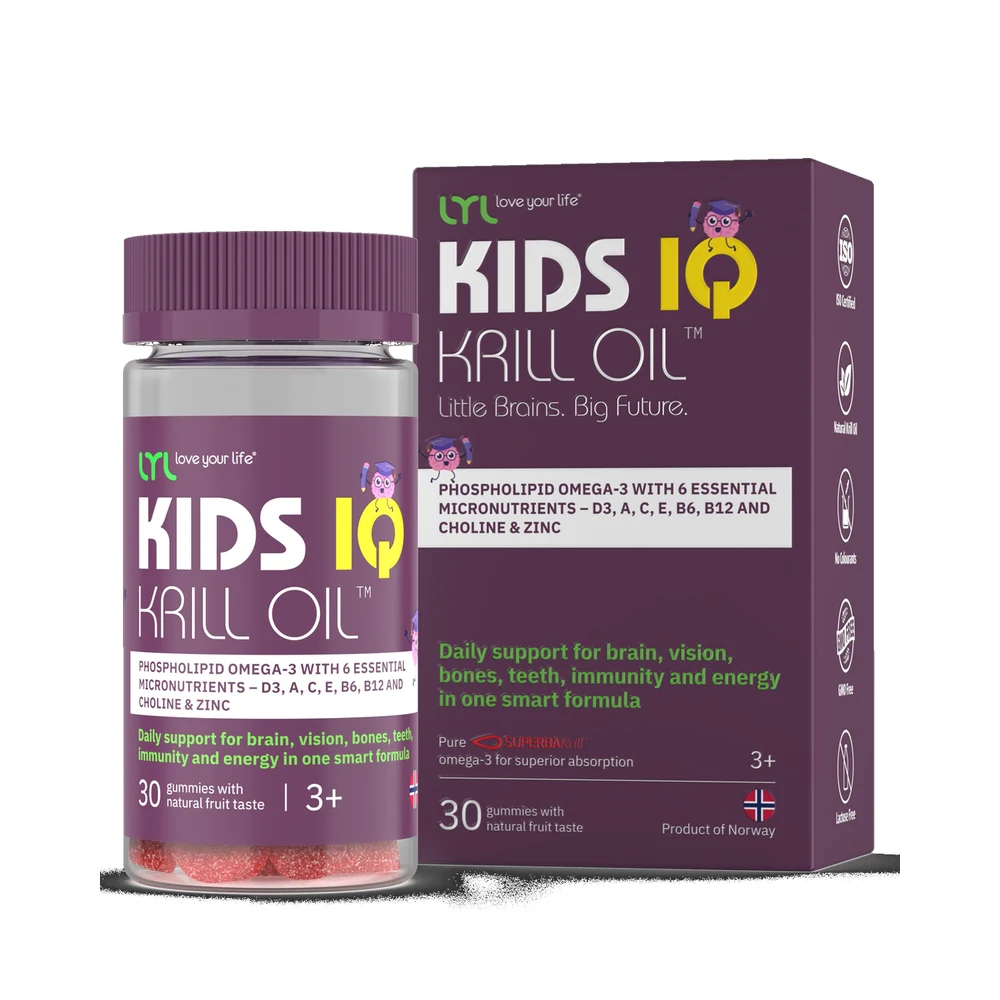
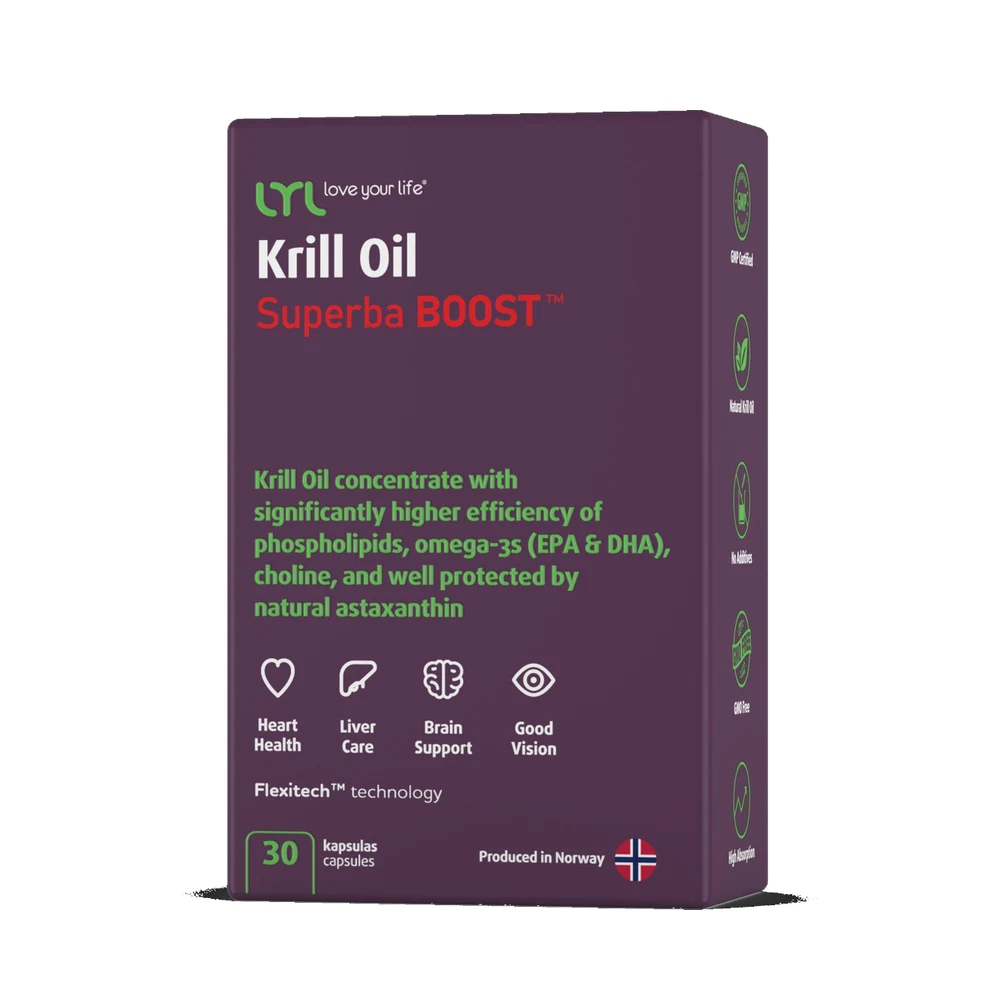
The body does not produce omega-3 fatty acids itself, so they have to come from the diet. Most people eat fish no more than once a week, and those who try fish oil often stop because of its specific taste and aftertaste. Krill oil solves both problems at once: the omega-3 is in a different chemical form and there is no aftertaste.
- 1Phospholipids, not triglyceridesIn krill oil the omega-3 is bound in phospholipids, the same as in the human cell membrane. Studies have compared how the phospholipid and triglyceride forms reach the heart, brain and liver, and the phospholipid form reaches the target organs better.
- 2Omega-3 index rises in 30 daysIn a published study, 30 days of krill oil use increased the omega-3 index by 121% compared with fish oil, from which the researchers concluded that one krill oil capsule is equivalent to four fish oil capsules. In LYL materials this effect is presented as up to 68% better absorption than fish oil.
- 3Astaxanthin and choline already in the formulaKrill oil naturally contains astaxanthin, which protects the fatty acids from oxidation, and choline. Two capsules provide 82.6 mg of choline, which exceeds the threshold for the EFSA claims on normal liver function and homocysteine metabolism.
- 4No fishy aftertasteFlexitech™ technology neutralises the odour and aftertaste. This is the main reason buyers stop using omega-3 products, so it affects repeat purchase.
- 5Four EFSA-approved claimsThe composition allows claims on heart, brain, vision and liver function, which gives the partner four different communication approaches for one product.
Adults 1 to 2 capsules a day, children from 3 years of age 1 capsule a day
- Superba BOOST™ is the latest Aker BioMarine generation and gives a higher phospholipid share than the previous Superba 2™.
- Astaxanthin and choline are naturally present in the formula, not added separately. Standard fish oil does not contain them.
- One 590 mg capsule gives 89 mg EPA and 41 mg DHA, so two capsules reach the 250 mg EPA and DHA threshold required for the EFSA heart claims.
- 100% traceability from catch to capsule, MSC certificate.
- Adults who want omega-3 without a fishy aftertaste
- People with elevated cardiovascular risk
- Intellectual workload and concentration
- Children from 3 years of age
- Those who have previously stopped taking fish oil because of the taste
- 5th place in the omega-3 category in Latvia, 4.63% market share, EUR 237,812 per yearSource: IQVIA Latvia, Sell-Out, 2025
- E-commerce share 40.25%Source: IQVIA Latvia, Sell-Out, 2025
Omega-3 is one of the largest and most stable supplement categories, and the LYL product enters it with a clear technological difference rather than on price. E-commerce accounts for 40.25% of the product's sales, one of the highest shares in the portfolio, so it works well in the online channel where the buyer studies the composition. Four EFSA claims allow a single SKU to be placed in four different categories within the store structure.
Scientific basis 7 sources
Comparing krill oil with fish oil in healthy volunteers, 30 days of use increased the omega-3 index by 121%. From this the researchers concluded that one krill oil capsule is equivalent to four fish oil capsules.
The study compares how omega-3 fatty acids reach the target organs — heart, brain and liver — depending on whether they are bound in phospholipids or in triglycerides.
Randomised study of the bioavailability of krill oil omega-3 compared with other forms.
The phosphatidylcholine form in krill oil provides a choline bioavailability that differs from other choline forms used in supplements.
Antarctic waters are among the cleanest in the world, which determines the contaminant level of the raw material.
Review of the effect of krill oil on the lipid profile and inflammatory markers.
Document prepared by Aker BioMarine on the European health claims applicable to the Superba raw material. Internal material of the raw material producer.